

Why the FIFA World Cup 2026 Is a Technology Milestone
The FIFA World Cup 2026 is not only the biggest tournament in football history but also one of the most complex technology projects ever executed in sports. The tournament spans three countries, multiple host cities, hundreds of facilities, and millions of spectators both in-person and online.
Managing an event of this scale requires advanced IT infrastructure capable of processing enormous amounts of data, supporting real-time communications, protecting critical systems from cyber threats, and delivering seamless digital experiences to fans worldwide.
From stadium operations and ticketing systems to live broadcasting and mobile applications, every aspect of the tournament depends on modern technology working flawlessly.
Artificial Intelligence Is Transforming Sports Operations
Artificial Intelligence is one of the most influential technologies behind the World Cup. Teams, organizers, broadcasters, and sponsors use AI to gain insights that were impossible to achieve just a few years ago.
AI systems can analyze player movements, identify tactical patterns, predict performance trends, and generate real-time statistics. Broadcasters use AI to create personalized viewing experiences, while organizers leverage machine learning to improve crowd management and operational planning.
Businesses can use similar AI solutions to automate routine tasks, improve customer service, analyze business performance, and increase operational efficiency.
Business Applications of AI
- Customer support automation
- Predictive business analytics
- AI-powered cybersecurity monitoring
- Workflow automation
- Document processing and summarization
- Business intelligence reporting
The Importance of Cloud Computing at Global Scale
Millions of football fans simultaneously accessing websites, mobile apps, ticketing platforms, and streaming services place enormous demands on infrastructure. Traditional servers alone cannot support this level of demand.
Cloud computing provides the scalability needed to automatically increase resources during peak traffic periods and reduce them when demand decreases.
This flexibility helps organizations maintain performance while controlling operational costs.
Businesses in Abu Dhabi are increasingly adopting cloud technologies to improve reliability, enable remote work, enhance collaboration, and simplify IT management.
Benefits of Cloud Solutions for Businesses
- Reduced infrastructure costs
- Scalable computing resources
- Improved disaster recovery
- Enhanced collaboration
- Remote accessibility
- Business continuity support
Cybersecurity: Protecting Millions of Users
Global sporting events are attractive targets for cybercriminals due to their high visibility and massive user base. A successful cyberattack could disrupt services, compromise sensitive information, and damage organizational reputation.
World Cup organizers invest heavily in cybersecurity technologies to monitor threats, detect suspicious activity, and respond rapidly to incidents.
Cybersecurity measures typically include:
- Advanced firewall protection
- Endpoint security solutions
- Network monitoring systems
- Threat intelligence platforms
- Multi-factor authentication
- Data encryption technologies
For businesses, cybersecurity is no longer optional. Organizations of all sizes face increasing threats from ransomware, phishing attacks, and data breaches.
Smart Stadiums: The Future of Connected Infrastructure
Modern World Cup stadiums use thousands of connected devices and sensors to create safer and more efficient environments.
Smart stadium technologies help manage:
- Crowd movement
- Energy consumption
- Security monitoring
- Access control systems
- Parking management
- Environmental conditions
These technologies demonstrate how connected infrastructure can improve operational efficiency while reducing costs.
Businesses can adopt similar smart technologies within offices, warehouses, manufacturing facilities, and retail environments.
Real-Time Data Analytics Drives Better Decisions
Every match generates millions of data points. Teams and organizers rely on advanced analytics platforms to transform raw information into actionable insights.
Data analytics helps:
- Improve player performance
- Optimize operations
- Enhance fan engagement
- Support marketing strategies
- Improve resource allocation
The same principles apply to businesses. Organizations that effectively collect and analyze data can make faster and more informed decisions.
Networking Infrastructure Behind the World Cup
Reliable network infrastructure is essential for broadcasting, communications, security systems, ticketing operations, and fan services.
High-performance networking supports:
- Ultra-fast data transmission
- Secure communications
- Cloud connectivity
- Real-time monitoring systems
- Video surveillance platforms
- Enterprise collaboration tools
Businesses that invest in modern networking infrastructure experience improved productivity, reliability, and user satisfaction.
Business Continuity and Disaster Recovery
World Cup operations cannot tolerate significant downtime. To ensure continuous service availability, organizers implement comprehensive disaster recovery and business continuity plans.
These strategies include:
- Redundant systems
- Backup data centers
- Automated failover solutions
- Regular backup procedures
- Continuous system monitoring
Businesses should adopt similar practices to protect operations from hardware failures, cyberattacks, and unexpected disruptions.
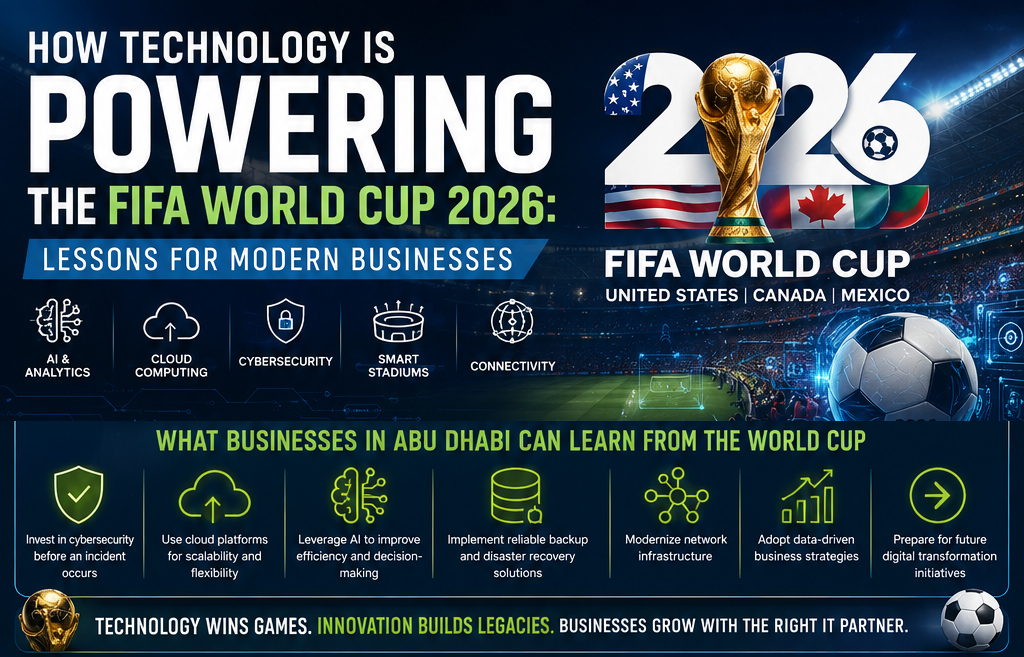
What Businesses in Abu Dhabi Can Learn from the World Cup
The technologies powering the FIFA World Cup 2026 highlight several key priorities for modern organizations:
- Invest in cybersecurity before an incident occurs
- Use cloud platforms for scalability and flexibility
- Leverage AI to improve efficiency and decision-making
- Implement reliable backup and disaster recovery solutions
- Modernize network infrastructure
- Adopt data-driven business strategies
- Prepare for future digital transformation initiatives
Businesses that embrace these technologies will be better positioned to compete, grow, and adapt in an increasingly digital economy.